
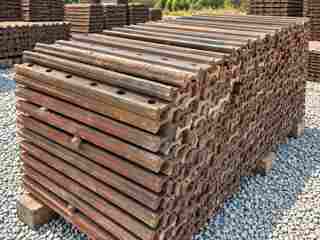
Joint Bars
Select the rail size, hole pattern, and pair quantity.
ⓘ Identification & Terminology GuideCorrect identification requires the rail section and the bar's profile/drilling—not hole count alone.
Open Guide
Correct identification requires the rail section and the bar's profile/drilling—not hole count alone.
Original MidStates identification schematic. Not to scale and not an installation or engineering drawing.
Joint Bar Identification & Terminology
A bar fitted to the web area on each side of adjoining rail ends to form a bolted rail joint.
The two mating bars used at one rail joint.
The number of bolt holes in the bar; this does not by itself identify the rail section.
The bolt-hole arrangement and center-to-center dimensions used to match the rail-end drilling.
The shaped bearing surfaces of the bar that fit the rail profile around the web/head/base transition.
How to identify what you have
- Identify the rail section the bars fit, if possible.
- Count the holes and measure overall bar length and height.
- Measure end-to-first-hole and center-to-center hole spacing.
- Record bolt-hole diameter if known.
- Photograph any stamped section, manufacturer or part markings and both bar faces.
What to measure
- Overall bar length
- Overall bar height
- End to first hole center
- Hole center-to-center spacing
- Bolt-hole diameter
What photos help MidStates
- Full outside face
- Full inside/fishing face
- End profile
- Markings
- Bar against the matching rail section if available
Common identification mistakes
- Ordering by 4-hole or 6-hole description only
- Assuming similar-looking bars fit the same rail
- Measuring from hole edge instead of hole center
Technical references & source notes
Reference index for rail sections, joint bars, compromise joints, tie plates, switches, turnout components, frogs, guard rails and fasteners.
Open authoritative public sourceReference for terminology and compatibility principles covering plates, spikes, anchors, joint bars and related industrial-track materials.
Open authoritative public sourceReference for rail-section terminology and dimensional identification. MidStates diagrams are original and are not copies of the UP drawing.
Open authoritative public sourceMidStates uses external publications to support technical facts and terminology. The explanatory text, diagrams and presentation on this page are original MidStates content and do not reproduce railroad or AREMA drawings.
* Required fields
One pair of joint bars is used at each rail joint.
How do I determine the drilling pattern?
A: Measure from the end of the rail to the center of the first bolt hole.
B: Measure center-to-center between bolt holes.
Also note the number of holes and bolt-hole diameter if known. If you are unsure, leave the optional drilling-pattern field blank and MidStates can confirm it during follow-up.